Contents
- 1 What Is TDS and Why Is It Important?
- 2 How Does TDS Work in Practice?
- 3 Who Is Responsible for Deducting TDS?
- 4 TDS Payment Online: How Does the Process Work?
- 5 What Payment Methods Are Available for Online TDS Payment?
- 6 Major Benefits of TDS
- 7 TDS vs Income Tax: Are They the Same?
- 8 Important Change From 2026: Income Tax Act 2025
- 9 Common Mistakes During Online TDS Payment
- 10 How to Make TDS Payment Online More Efficient
- 11 TDS Records, Challans, and Digital Proof
- 12 Frequently Asked Questions About TDS Payment Online
- 13 Is TDS paid online?
- 14 Is TDS an additional tax?
- 15 Can TDS be paid through UPI?
- 16 What is ITNS 281N?
- 17 Why is checking the tax year important?
- 18 Conclusion
What Is TDS and Why Is It Important?
TDS stands for Tax Deducted at Source. It is designed to collect income tax at the point where certain taxable income is paid or credited instead of waiting until the end of the tax year. For example, when a company pays certain professional fees, contractual payments, salary, rent, or other specified amounts, the payer may be required to deduct tax before making the net payment.
The deducted amount is subsequently deposited with the government and credited against the recipient’s tax liability. Therefore, TDS is generally not a separate additional tax; it represents tax collected in advance against applicable income-tax liability.
TDS also creates a reporting trail between the payer, recipient, and tax administration. This can make tax collection more systematic and help reduce delays in government revenue collection.
Importantly, TDS does not apply to every payment. Applicability depends on the nature of the payment, applicable threshold, recipient status, and other conditions prescribed under the relevant tax provisions.
How Does TDS Work in Practice?
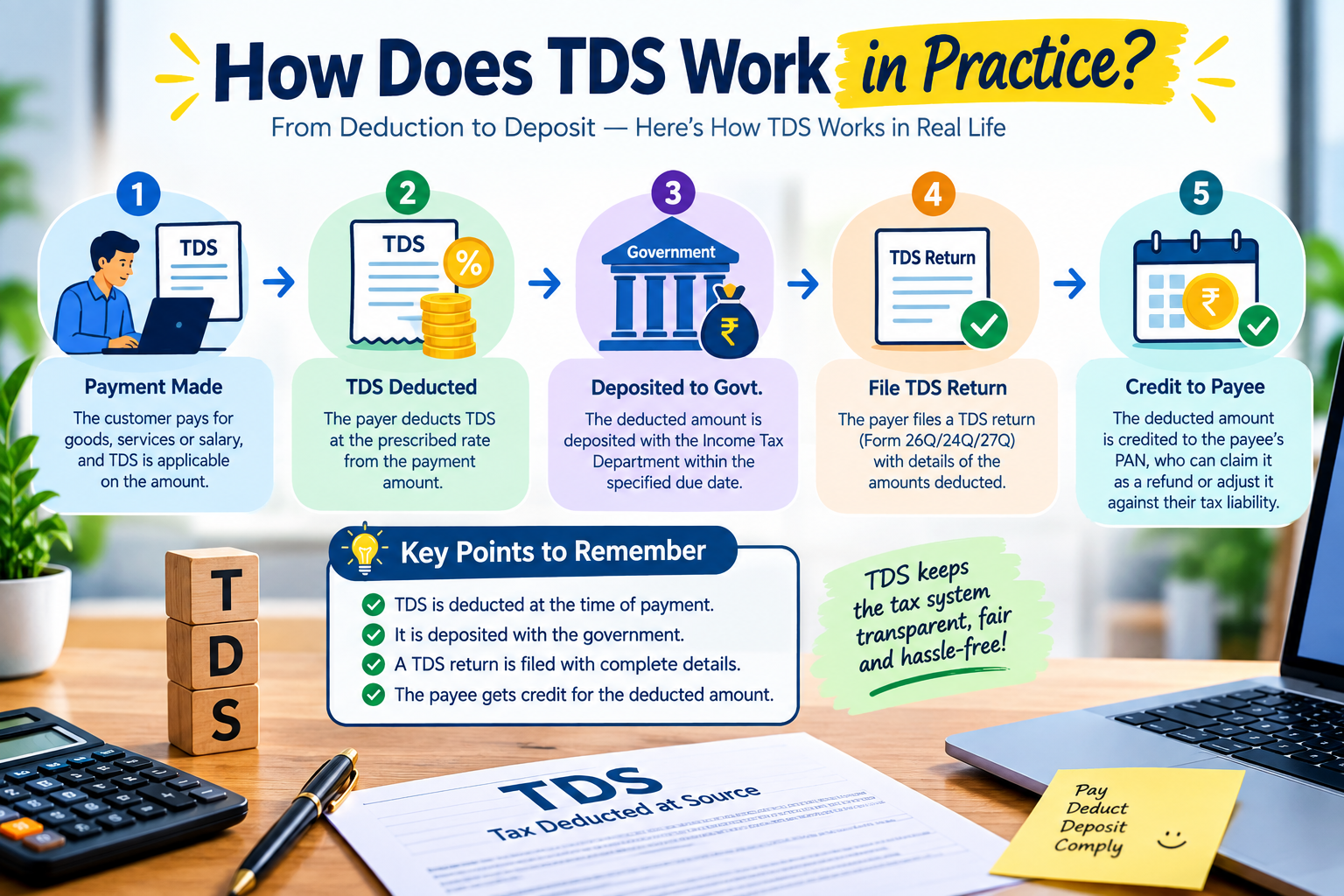
The basic TDS process can be understood through four stages: identifying the transaction, determining whether deduction is required, deducting the applicable amount, and depositing/reporting that amount to the government.
Suppose a business makes a payment that falls under a TDS provision. Before paying the recipient, the business determines the applicable rate and taxable amount. The required tax is deducted and the remaining amount is paid to the recipient. The deducted tax is then deposited with the government through the applicable tax-payment system.
The recipient can subsequently receive credit for the TDS against their overall income-tax liability, subject to the applicable rules and proper reporting.
A simplified example is shown below:
| Particular | Example |
|---|---|
| Gross payment | ₹50,000 |
| Illustrative TDS | ₹5,000 |
| Net payment to recipient | ₹45,000 |
| TDS deposited with government | ₹5,000 |
The ₹5,000 in this example is purely illustrative; the actual TDS rate and threshold depend on the specific transaction and applicable law.
Who Is Responsible for Deducting TDS?
The person or organization making a payment is generally referred to as the deductor, while the person receiving the income is commonly called the deductee. Depending on the transaction, businesses, employers, organizations, government bodies, and other persons can have TDS responsibilities.
The deductor must first determine whether the payment falls within a provision requiring tax deduction. This involves examining the payment’s nature, amount, timing, recipient, and applicable legal conditions.
One important point is that TDS compliance is not simply about transferring money online. A deductor may also have responsibilities relating to documentation, reporting, statements, certificates, and maintaining appropriate records.
For businesses, an organized TDS process can therefore involve accounting software, payroll systems, banking records, tax statements, and the income-tax e-Filing portal.
The recipient should also review TDS information because incorrect PAN details, incorrect deduction amounts, or reporting discrepancies can create problems when reconciling tax information.
TDS Payment Online: How Does the Process Work?
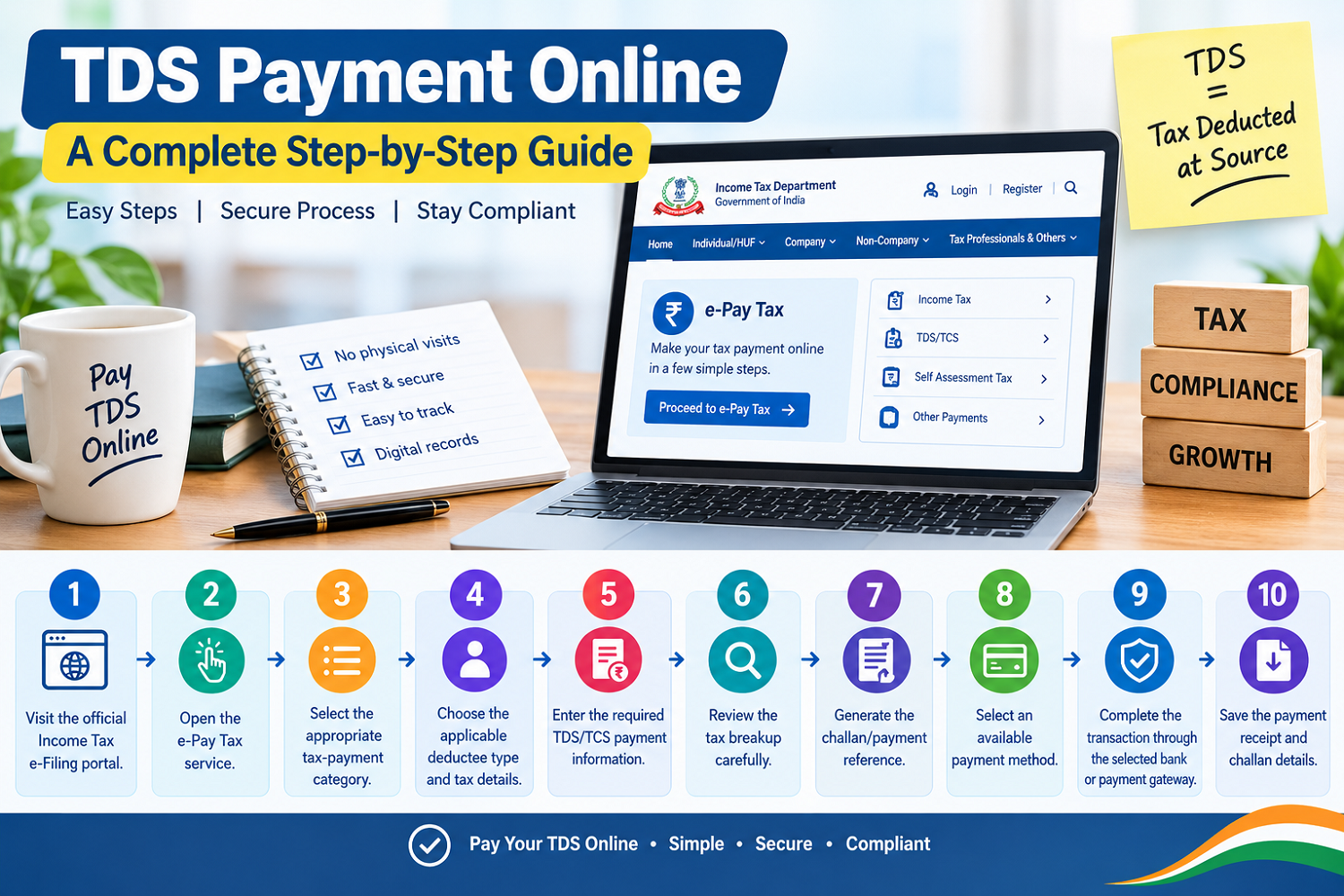
For current Indian tax payments, the Income Tax Department provides an e-Pay Tax facility through its e-Filing portal. The system supports both pre-login and post-login payment routes, subject to the applicable requirements.
For TDS/TCS payments for Tax Year 2026–27 onward, the Income Tax Department’s current guidance provides a “Pay TDS/TCS” option under the e-Pay Tax system. The system allows relevant section-wise payment details to be entered while generating the payment challan.
A simplified online process is:
- Visit the official Income Tax e-Filing portal.
- Open the e-Pay Tax service.
- Select the appropriate tax-payment category.
- Choose the applicable deductee type and tax details.
- Enter the required TDS/TCS payment information.
- Review the tax breakup carefully.
- Generate the challan/payment reference.
- Select an available payment method.
- Complete the transaction through the selected bank or payment gateway.
- Save the payment receipt and challan details.

Read More: TDS Payment Online: A Complete Step-by-Step Guide
The exact fields can vary according to the type of payment and applicable tax provisions.
What Payment Methods Are Available for Online TDS Payment?
One of the useful developments in online tax administration is the availability of multiple payment methods. According to the Income Tax Department’s current e-Pay Tax guidance, taxpayers can use Net Banking, Debit Card, RTGS/NEFT, Payment Gateway, and Pay at Bank Counter, subject to applicable conditions. Payment Gateway can support options such as credit card, debit card, UPI, and net banking.
| Payment Method | General Description |
|---|---|
| Net Banking | Payment through an authorized bank |
| Debit Card | Payment using an eligible debit card |
| RTGS/NEFT | Bank-to-bank electronic tax payment |
| Payment Gateway | Online payment through supported gateway options |
| Bank Counter | Eligible payments through an authorized bank branch |
This flexibility can be particularly useful for organizations that have different banking arrangements.
Before making a payment, users should verify the available payment modes displayed by the official portal because supported banks, payment arrangements, and transaction conditions can change.
Major Benefits of TDS
TDS provides several important benefits to the tax system and taxpayers. One major benefit is regular tax collection. Instead of the government receiving all applicable tax only at the end of the year, tax can be collected progressively when qualifying payments occur.
Another benefit is improved transparency. Because deductions are recorded and reported, taxpayers can reconcile their income and tax information more systematically.
TDS can also reduce the possibility of a large unexpected tax liability at the end of the year for recipients whose income has already been subject to appropriate withholding.
For the government, TDS provides a structured mechanism for collecting tax from a wide range of transactions.
For businesses, digital tax-payment facilities can also simplify the administrative process because payment records, challans, and transaction histories can be accessed electronically.
Overall, TDS connects payment, tax deduction, reporting, and tax credit within a broader compliance framework.
TDS vs Income Tax: Are They the Same?
TDS and income tax are closely connected, but they are not exactly the same thing.
Income tax is the broader tax liability arising from taxable income under applicable law. TDS, on the other hand, is a mechanism through which tax is collected at the source of specified payments.
Consider a simple conceptual example. A person may earn taxable income during a year and have TDS deducted from certain payments received during that period. At the time of filing the income-tax return, the person’s overall tax liability is calculated according to the applicable rules. TDS already deducted can generally be considered as tax paid/credit, subject to proper reporting and verification.
| Concept | Meaning |
|---|---|
| Income Tax | Tax liability on taxable income |
| TDS | Tax collected through deduction at source |
| Deductor | Person making the qualifying payment |
| Deductee | Person receiving the payment |
| TDS Credit | Credit for eligible tax already deducted |
This distinction is important because seeing TDS on a payment statement does not automatically mean the recipient has a separate additional tax liability equal to that amount.
Important Change From 2026: Income Tax Act 2025
A particularly important development for anyone researching TDS payment online in 2026 is the transition from the Income Tax Act, 1961 to the Income Tax Act, 2025.
According to the Income Tax Department, the applicable Act depends on when the earlier of payment or credit occurs. Transactions up to 31 March 2026 continue under the old Act, while transactions from 1 April 2026 onward are governed by the corresponding provisions of the new Act.
The department also states that TDS rates and monetary thresholds have been retained, while the provisions have been reorganized into a consolidated presentation.
This is especially important for people searching older TDS guides online. An article may mention sections such as 194C or 194J, but for transactions occurring from 1 April 2026, the corresponding provisions under the new framework need to be used. The Income Tax Department specifically warns that using old section references for post-1 April 2026 transactions can cause system-level validation or processing issues.
Common Mistakes During Online TDS Payment
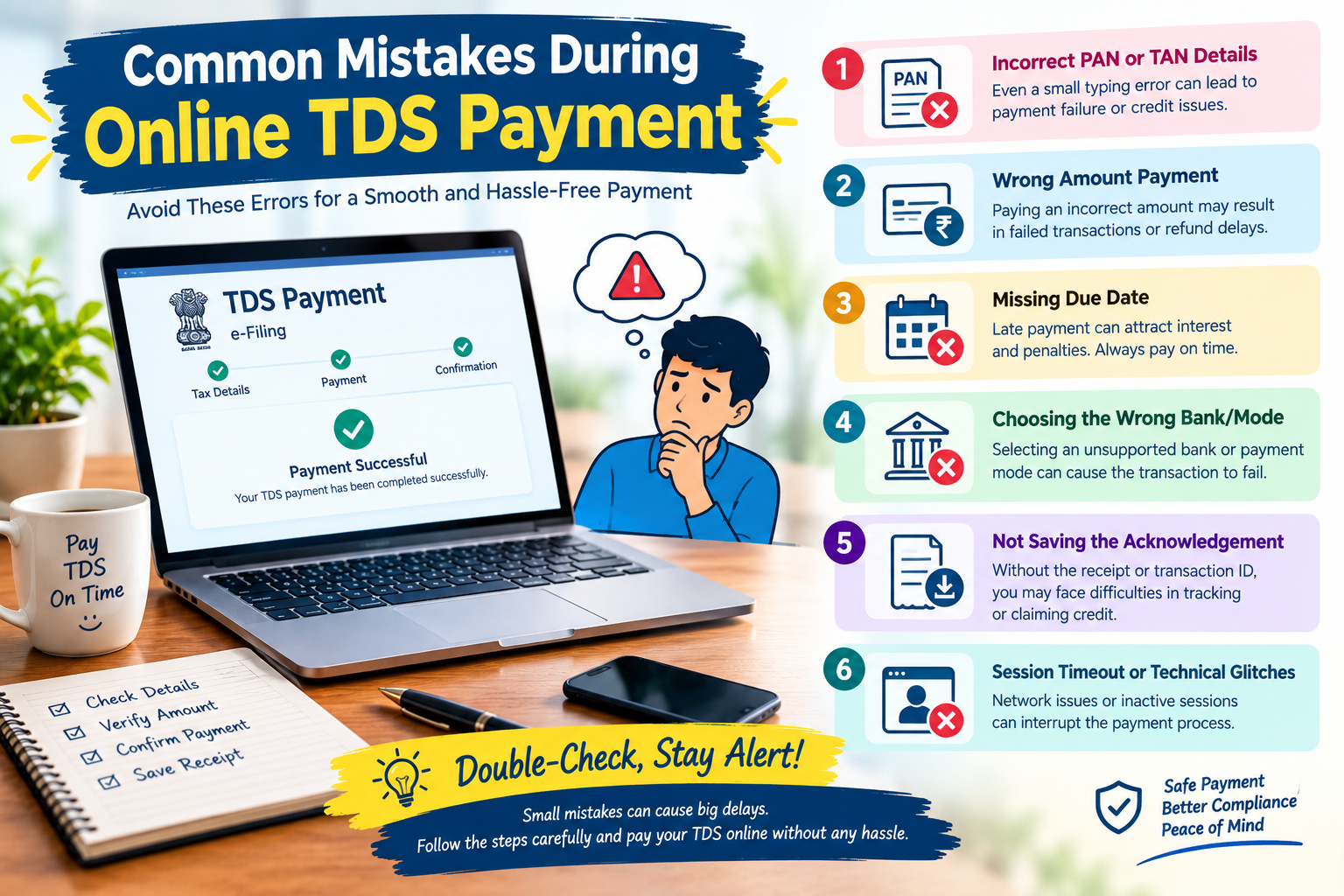
Online payment makes the process convenient, but mistakes can still happen. One of the most common problems is entering incorrect taxpayer or deductor information. Another is selecting an incorrect tax-payment category or section.
Incorrect amounts can also create reconciliation problems. Before clicking the final payment button, users should carefully review the tax breakup, applicable year, payment category, and other information displayed on the portal.
Another mistake is failing to preserve payment evidence. The Income Tax Department states that successful payment details and challan receipts can be accessed through the Payment History section of the e-Pay Tax service.
A practical checklist is:
- Verify PAN/TAN.
- Select the correct tax year.
- Check the applicable TDS provision.
- Verify the amount.
- Review the deductee information.
- Confirm the payment mode.
- Save the challan/receipt.
- Reconcile the payment with accounting records.
These small checks can prevent avoidable compliance problems.
How to Make TDS Payment Online More Efficient
A well-organized TDS process can save considerable time, especially for businesses handling multiple deductions each month or quarter. The first step is to maintain accurate payment records. Every qualifying payment should be categorized according to its nature before the TDS amount is calculated.
Businesses can also use accounting or payroll software to reduce manual calculations, but software outputs should still be reviewed against current tax rules.
Another useful practice is maintaining a dedicated compliance calendar. Important activities such as deduction, deposit, return filing, reconciliation, and certificate-related tasks can be tracked separately.
The online e-Pay Tax system also provides a centralized environment for creating challans and recording payment history.
A simple workflow can therefore be:
Transaction → TDS applicability check → Calculation → Deduction → Online payment → Record keeping → Reconciliation → Reporting
This approach makes TDS administration more systematic and reduces the chance of missing important information.
TDS Records, Challans, and Digital Proof
Keeping records is one of the most overlooked aspects of tax compliance. A successful online payment should not simply be treated as the end of the process. The taxpayer or deductor should preserve relevant transaction details, challan information, payment confirmation, accounting records, and other supporting documents.
The current e-Pay Tax system provides payment history and challan-related functionality through the Income Tax Department’s portal.
A useful digital record system might include:
| Record | Why It Matters |
|---|---|
| Payment receipt | Evidence of successful payment |
| Challan/CRN | Identifies the tax payment |
| Bank transaction record | Financial confirmation |
| TDS calculation | Supports the amount deducted |
| Deductee details | Helps reconciliation |
| Accounting entry | Connects payment to books |
Maintaining these records digitally can make future reconciliation, return preparation, and responding to tax-related queries considerably easier.
Frequently Asked Questions About TDS Payment Online
Is TDS paid online?
Yes. India’s Income Tax Department provides online tax-payment facilities through its e-Pay Tax service. Various payment methods are available depending on eligibility and the transaction.
Is TDS an additional tax?
Generally, TDS is a mechanism for collecting tax at source. The amount deducted can generally be credited against the recipient’s applicable tax liability, provided the deduction is correctly reported.
Can TDS be paid through UPI?
The Income Tax Department’s current guidance states that the Payment Gateway mode can support UPI along with other options such as credit card, debit card, and net banking, subject to the payment gateway’s availability.
What is ITNS 281N?
For Tax Year 2026–27 onward, ITNS 281N is the TDS/TCS challan used under the Income Tax Act, 2025. The Income Tax Department notes that ITNS 281 continues to apply for payments under the Income Tax Act, 1961.
Why is checking the tax year important?
Because India’s TDS framework changed from 1 April 2026, selecting the appropriate Act and tax year is particularly important when making payments or completing compliance activities.
Conclusion
TDS is an important tax-collection mechanism that allows applicable tax to be deducted when specified payments are made or credited. It connects the payer, recipient, government, and tax-credit system while encouraging regular tax compliance.
For people searching for tds payment online, the biggest practical development in 2026 is the Income Tax Department’s e-Pay Tax system. It provides a centralized process for creating challans, selecting payment options, completing tax payments, and accessing payment history.
At the same time, users should pay close attention to the transition to the Income Tax Act, 2025. Although the department says the TDS rates and monetary thresholds have been retained, the applicable legal references have changed for transactions from 1 April 2026.
For actual compliance, the safest approach is to verify the applicable provision, threshold, rate, tax year, and payment details using the current official Income Tax Department guidance rather than relying on an older TDS article.