Which Business Is Most Profitable in India? 10 High-Potential Ideas for 2026
Which business is most profitable in India? There is no single answer because the most profitable business depends on investment capacity, market demand, operating costs, location, business skills, and the entrepreneur’s ability to scale. However, technology services, renewable energy, food processing, e-commerce, healthcare, education, logistics, specialized manufacturing, digital marketing, and B2B services are among the strongest opportunities in the Indian market.
India has one of the world’s largest consumer markets, a rapidly expanding digital ecosystem, a large working-age population, and growing demand across both urban and rural areas. This combination creates opportunities for entrepreneurs at different investment levels.
The interesting point is that a profitable business does not necessarily need to be a huge company. A small specialized service with low operating costs can sometimes generate better margins than a large business with heavy infrastructure and inventory requirements.
Understanding What Makes a Business Profitable in India
Profitability is often misunderstood. Many people assume that a business with high sales is automatically highly profitable. In reality, revenue and profit are two different measurements.
A business may generate ₹1 crore in annual sales but retain only a small percentage after salaries, rent, marketing, taxes, inventory, transportation, technology, interest, and other expenses. Another company may generate ₹30 lakh in sales while keeping a significantly larger percentage as operating profit.
Therefore, when evaluating which business is most profitable in India, entrepreneurs should consider several factors rather than looking only at turnover.
The first factor is gross margin. A business with strong margins has more room to cover overhead expenses. The second is customer retention. Businesses that repeatedly sell to existing customers usually spend less on acquiring every new customer.
The third factor is scalability. A consulting business, software company, or digital service can potentially serve customers in different cities without opening a physical branch everywhere. In contrast, a restaurant may need additional physical locations to grow.
The fourth factor is capital intensity. Businesses requiring factories, warehouses, vehicles, or expensive equipment can demand significant initial investment.
The fifth factor is market growth. A business operating in a growing industry can find new customers more easily than one operating in a declining market.
Key profitability factors
Factor
Why It Matters
Initial investment
Determines financial entry barrier
Gross margin
Shows earning potential per sale
Operating cost
Affects net profitability
Customer demand
Determines market opportunity
Repeat purchases
Creates recurring revenue
Scalability
Makes expansion easier
Competition
Influences pricing power
Technology
Can reduce operational costs
Location
Affects customers and expenses
Management
Determines execution quality
A smart entrepreneur therefore asks a better question: Which business can generate sustainable profit with the resources I have?
That question is much more useful than simply asking which industry has the highest turnover.
Technology and IT Services: A High-Margin Business Opportunity
Technology services are among the most attractive businesses for entrepreneurs who possess technical or digital skills. The sector includes software development, mobile applications, website development, cloud services, cybersecurity, artificial intelligence solutions, automation, data analytics, and IT consulting.
One reason technology businesses can become highly profitable is their relatively low physical infrastructure requirement. A service company may begin with a small team, computers, internet connectivity, software subscriptions, and a professional website.
Unlike traditional businesses, digital companies can potentially sell services outside their immediate geographic location. An Indian software developer can work with customers in another Indian state or even international clients.
Artificial intelligence is creating another layer of opportunity. Businesses increasingly need automation for customer support, marketing, data processing, document management, sales, and internal workflows. Entrepreneurs who can provide practical AI solutions to small and medium-sized companies may find significant opportunities.
However, technology is not automatically profitable. Competition is intense, and clients expect high-quality work. A generic web-development agency may struggle to stand out, while a company specializing in a particular industry—such as healthcare software, logistics automation, legal technology, or accounting systems—may create stronger positioning.
Technology business models
Business Model
Investment Level
Scalability
Potential
Web development
Low
High
High
Mobile app development
Medium
High
High
AI automation
Medium
Very High
Very High
Cybersecurity services
Medium
High
Very High
SaaS product
Medium–High
Very High
Very High
IT consulting
Low–Medium
High
High
Cloud services
Medium
High
High
The most attractive technology model is often one that combines specialization with recurring revenue. For example, instead of building one website and moving to the next client, an entrepreneur could provide website management, security, hosting, analytics, and automation through monthly subscriptions.
Renewable Energy and Solar Businesses: The Green Opportunity
Renewable energy is another sector with substantial long-term potential in India. Solar power, in particular, has expanded rapidly.
According to India’s Ministry of New and Renewable Energy, cumulative solar capacity reached approximately 162.15 GW by June 30, 2026, while total renewable-energy capacity excluding large hydro reached about 236.52 GW.
This growth creates opportunities beyond simply owning large solar farms. Entrepreneurs can participate in installation, maintenance, equipment distribution, solar consulting, rooftop systems, cleaning, monitoring, financing support, and energy-efficiency services.
The government’s PM-KUSUM programme has also created opportunities around solar-powered agricultural infrastructure, including decentralized renewable-energy plants and solar agriculture pumps.
For smaller entrepreneurs, solar installation and maintenance may be more accessible than utility-scale generation.
A local company could install rooftop systems for homes, schools, offices, shops, warehouses, and factories. After installation, it can generate additional revenue through maintenance contracts and system monitoring.
Solar business opportunities
Business
Investment
Revenue Model
Rooftop solar installation
Medium
Project-based
Solar maintenance
Low–Medium
Recurring
Solar equipment dealership
Medium
Product margin
Solar consulting
Low
Consulting fees
Solar cleaning
Low
Service fees
Solar monitoring
Low–Medium
Subscription
Solar project development
High
Long-term returns
The Ministry also reports that India’s solar installed capacity has grown dramatically since 2014, reflecting the scale of the opportunity.
The important lesson is that entrepreneurs do not necessarily need to become energy producers. They can build businesses around the ecosystem supporting renewable energy.
Food Processing: Turning Agricultural Products Into Higher-Value Products
Food is one of India’s largest and most dependable consumer categories. People may reduce spending on luxury products during difficult economic periods, but food remains an essential requirement.
This makes food processing particularly interesting.
Instead of selling agricultural products in their raw form, entrepreneurs can create higher-value products through processing, packaging, branding, preservation, and distribution.
The Ministry of Food Processing Industries has been supporting food-processing development through various programmes. Its Production Linked Incentive scheme for food processing was designed around expansion of processing capacity, investment, employment, sales, and exports.
This demonstrates why food processing can be more than a traditional small business. It can develop into a scalable manufacturing and consumer-brand opportunity.
Food-processing opportunities
Product Category
Potential Advantage
Spices
Regular household demand
Pickles
Regional differentiation
Packaged snacks
Large consumer market
Millet foods
Health-oriented positioning
Frozen foods
Convenience
Ready-to-cook products
Time-saving
Sauces
Repeat purchases
Dehydrated foods
Longer shelf life
Regional foods
Unique branding
Private-label products
B2B opportunity
The major challenge is quality control. Food businesses must pay attention to hygiene, packaging, shelf life, regulatory compliance, sourcing, and distribution.
A strong food-processing business should therefore combine quality + branding + distribution + repeat purchasing.
The biggest opportunity may not be selling a generic product. It may be creating a recognizable brand around a specific regional or consumer need.
E-Commerce and D2C Brands: Selling Directly to Indian Consumers
E-commerce has changed the way Indian consumers discover and purchase products. Entrepreneurs no longer need to own a large chain of physical stores to build a consumer brand.
A small business can develop products, establish a brand identity, market through digital channels, and sell through online marketplaces or its own website.
The D2C—or direct-to-consumer—model can be particularly attractive because the business can build a direct relationship with customers.
Potential categories include:
Fashion accessories
Home décor
Beauty products
Kitchen products
Pet products
Personalized gifts
Fitness accessories
Stationery
Regional products
Specialty foods
However, e-commerce is not simply about listing products online. Competition can be intense, and advertising costs can reduce margins.
The strongest brands usually differentiate themselves through product quality, design, packaging, customer service, community building, or a unique proposition.
D2C profitability model
Stage
Main Activity
1
Identify customer problem
2
Research product demand
3
Develop or source product
4
Build brand identity
5
Create online storefront
6
Test marketing
7
Measure customer acquisition cost
8
Improve conversion rate
9
Encourage repeat purchases
10
Expand product range
A key metric is customer lifetime value. If a customer purchases repeatedly, the business can spend more intelligently on marketing.
For example, a company selling consumable products may have stronger repeat-purchase economics than a business selling a product that customers buy only once every several years.
Therefore, the most profitable e-commerce businesses are often not those with the cheapest products, but those with strong differentiation and repeat customers.
Healthcare and Wellness Services: A Demand-Driven Industry
Healthcare represents another major business opportunity because demand is continuous. India’s growing population, increasing awareness, urbanization, and demand for convenient healthcare services create opportunities across multiple categories.
Healthcare entrepreneurship does not necessarily mean opening a large hospital.
Smaller business models can include diagnostic services, medical equipment distribution, physiotherapy centres, elderly-care services, home healthcare support, pharmacy-related services where legally permitted, healthcare technology, medical billing, and specialized wellness services.
The important consideration is that healthcare is highly sensitive and regulated. Entrepreneurs must prioritize professional qualifications, licenses, patient safety, data protection, and applicable laws.
Healthcare business models
Business
Capital Requirement
Scalability
Home healthcare support
Medium
High
Diagnostic centre
Medium–High
Medium
Medical equipment distribution
Medium
High
Healthcare software
Medium
Very High
Elder-care services
Medium
High
Physiotherapy centre
Medium
Medium
Medical billing services
Low
High
Healthcare consultancy
Low–Medium
High
Healthcare technology can be especially interesting because software can solve operational problems without requiring the entrepreneur to operate a hospital.
For example, appointment management, patient communication, inventory systems, billing, documentation, and workflow automation can become specialized B2B services.
The strongest opportunity therefore lies where healthcare expertise and technology intersect.
Education, Coaching and Skill Development Businesses
Education is another sector with significant entrepreneurial potential in India.
The traditional coaching model has expanded into online learning, professional certification, skill development, test preparation, language training, vocational education, coding, digital marketing, communication skills, and career-focused courses.
One major advantage of education businesses is that knowledge can be converted into reusable digital products.
A teacher might initially provide one-to-one classes. Later, the same expertise can be transformed into group classes, recorded courses, downloadable resources, memberships, workshops, or corporate training.
Education business comparison
Model
Initial Cost
Scalability
Local coaching centre
Medium
Medium
Online tutoring
Low
High
Recorded courses
Low–Medium
Very High
Corporate training
Medium
High
Test preparation
Medium
High
Skill-development platform
Medium–High
Very High
Language training
Low
High
The most profitable education businesses generally solve a specific problem.
Instead of creating a broad course called “Learn Everything About Business,” an entrepreneur could develop a focused programme such as “Digital Marketing for Local Retailers” or “Excel Skills for Entry-Level Finance Jobs.”
Specificity helps marketing because the customer immediately understands what problem is being solved.
The education sector also benefits from recurring models. Membership communities, monthly learning subscriptions, certification programmes, and ongoing mentorship can create predictable revenue.
The major challenge is trust. Students and parents want evidence of quality. Therefore, testimonials, transparent curriculum, instructor credibility, measurable outcomes, and student support are essential.
Logistics, Delivery and Warehousing: The Infrastructure Behind Commerce
Every product sold online or through modern retail requires transportation and logistics. As businesses expand across cities and regions, demand for delivery, storage, inventory management, packaging, and fulfilment increases.
This creates opportunities for entrepreneurs who understand local markets.
A logistics business can specialize in last-mile delivery, regional transportation, cold-chain logistics, warehouse management, packaging, fulfilment, or B2B transportation.
The most profitable model depends heavily on asset utilization.
A vehicle that remains idle generates no revenue while still producing costs. Therefore, successful logistics businesses focus on routing, scheduling, utilization, maintenance, fuel management, and customer contracts.
Logistics opportunities
Business Type
Main Customers
Last-mile delivery
E-commerce companies
B2B transport
Manufacturers
Cold-chain logistics
Food & healthcare
Warehousing
Retailers
Fulfilment services
Online sellers
Packaging services
E-commerce businesses
Inventory management
SMEs
Regional courier
Local businesses
Cold-chain logistics is particularly interesting for products requiring controlled temperatures, including certain food and healthcare products.
The challenge is capital expenditure. Vehicles, warehouses, technology, insurance, fuel, maintenance, and labour can increase costs substantially.
For this reason, entrepreneurs with limited capital may begin with an asset-light logistics model, coordinating transport and fulfilment instead of owning every physical asset themselves.
Technology can further improve profitability through route optimization, real-time tracking, digital invoicing, and automated customer communication.
Specialized Manufacturing: Building Products Instead of Reselling Them
Manufacturing can produce significant profits when an entrepreneur identifies a product with strong demand, manageable production costs, and limited direct competition.
India has opportunities across electronics components, packaging, construction materials, industrial products, textiles, furniture, machinery components, consumer products, and specialized equipment.
However, manufacturing requires careful planning. Purchasing machinery alone does not create profitability.
The entrepreneur must understand:
Raw-material costs
Production capacity
Quality control
Labour requirements
Electricity consumption
Inventory management
Distribution
Equipment maintenance
Working capital
Customer contracts
A small manufacturer may be more profitable by focusing on a specialized B2B component rather than trying to compete with large consumer brands.
For example, supplying a specific component to ten industrial customers can potentially be more predictable than trying to sell thousands of consumer products through expensive advertising.
Manufacturing strategy
Strategy
Benefit
Niche product
Less direct competition
B2B contracts
Predictable demand
Quality specialization
Higher pricing potential
Automation
Lower unit costs at scale
Local sourcing
Supply-chain flexibility
Export readiness
Larger market
Custom production
Higher differentiation
Manufacturing can therefore be extremely profitable—but it usually requires more capital and operational discipline than digital services.
For entrepreneurs with technical knowledge and access to financing, however, specialized manufacturing can become a powerful long-term business.
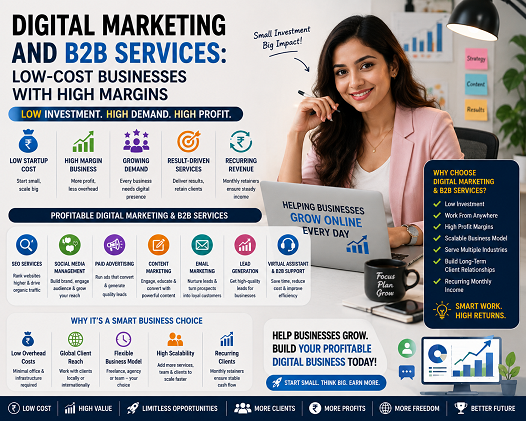
Digital Marketing and B2B Services: Low-Cost Businesses With High Margins
One of the most accessible business categories in India is professional B2B services.
Businesses constantly need help with marketing, accounting, design, recruitment, websites, social media, search optimization, content, automation, consulting, and customer support.
A service business can often start with relatively little physical infrastructure.
For example, a digital marketing agency may begin with a laptop, internet connection, software subscriptions, a website, and specialized knowledge.
But competition is high. Simply calling yourself a “digital marketing agency” may not create a strong competitive advantage.
The better approach is specialization.
An agency might focus on:
SEO for healthcare companies
Marketing for restaurants
Lead generation for real-estate firms
Social media for local businesses
B2B LinkedIn marketing
AI automation for small businesses
E-commerce advertising
Content marketing for technology companies
B2B service profitability
Service
Startup Cost
Recurring Revenue Potential
SEO
Low
Very High
Social media management
Low
High
Graphic design
Low
Medium
Video editing
Low
High
Recruitment
Low–Medium
Medium
Bookkeeping
Low
Very High
AI automation
Low–Medium
Very High
Business consulting
Low
High
Web maintenance
Low
High
Lead generation
Low–Medium
High
The secret is to move from selling hours to selling outcomes.
Instead of saying, “We provide 20 hours of marketing work,” a business can sell a clearly defined solution such as lead generation, website maintenance, appointment generation, or monthly business reporting.
This makes pricing easier to understand and can improve recurring revenue.
Comparing the Most Profitable Business Opportunities in India
Although the article focuses on ten major categories, entrepreneurs should compare them according to their own resources.
A high-capital entrepreneur may find renewable energy or manufacturing attractive. A skilled individual with limited capital may prefer software, consulting, education, or digital services.
Overall comparison
Business Sector
Investment
Profit Potential
Scalability
Risk
Technology/IT
Low–Medium
Very High
Very High
Medium
Solar/Renewable Energy
Medium–High
High
High
Medium
Food Processing
Medium
High
High
Medium
E-commerce/D2C
Low–Medium
High
Very High
High
Healthcare
Medium–High
High
High
Medium–High
Education
Low–Medium
High
Very High
Medium
Logistics
Medium–High
High
High
Medium–High
Manufacturing
High
Very High
High
High
Digital Marketing
Low
High
Very High
Medium
B2B Services
Low
High
High
Low–Medium
This comparison shows why there is no universal winner.
If the primary goal is low startup cost and high scalability, technology and specialized B2B services are strong candidates.
If the goal is long-term infrastructure opportunity, renewable energy may be attractive.
If the goal is consumer-brand creation, food processing and D2C e-commerce offer interesting possibilities.
If the goal is stable demand, healthcare, education, and food-related businesses can be considered.
Final Verdict: Which Business Is Most Profitable in India?
The most profitable business in India is not necessarily one specific industry; for many entrepreneurs, the strongest opportunities are specialized technology services, AI-enabled B2B services, renewable-energy solutions, food processing, and scalable digital businesses.
The right choice depends on the entrepreneur’s capital, skills, location, network, and risk tolerance.
For a person with limited capital, starting a business that requires heavy machinery or large inventory may create unnecessary financial pressure. A service-based business can be a better starting point because it allows the entrepreneur to test demand before making major investments.
For someone with technical expertise, software, AI automation, cybersecurity, or SaaS may offer exceptional scalability.
For someone with access to agricultural products and local supply chains, food processing may provide an opportunity to create a regional brand.
For an entrepreneur with capital and technical partners, solar installation, renewable-energy services, or specialized manufacturing may offer substantial long-term opportunities.
India’s renewable-energy expansion illustrates the scale of some emerging sectors. Official data shows solar capacity reached around 162.15 GW by June 2026, demonstrating how quickly the renewable ecosystem has developed. Meanwhile, food-processing policy continues to support investment, capacity expansion, employment, and exports.
Ultimately, profitability comes from solving a real customer problem better than competitors.
A successful entrepreneur should therefore evaluate five questions before starting:
Who is the customer?
What problem am I solving?
How much will customers pay?
How much will it cost to deliver?
Can the business generate repeat or recurring revenue?
The best business is the one where these five answers make economic sense.
In 2026, entrepreneurs should think beyond traditional concepts of “opening a shop” or “starting a company.” The biggest opportunities increasingly exist at the intersection of technology, convenience, specialization, sustainability, healthcare, food, education, and business services.
A small business can start locally and scale nationally. A digital company can begin with one person and eventually serve thousands of customers. A food producer can turn a regional recipe into a national brand. A solar installer can grow from residential projects into commercial energy solutions.
Therefore, instead of searching for a magical business that guarantees profit, entrepreneurs should search for a profitable problem—one that customers urgently want solved, one that can be solved efficiently, and one that can be scaled without costs growing as quickly as revenue.
That is the real answer to the question: which business is most profitable in India?