Identifying High-Scoring Defensive Fragility for Both Teams to Score Markets in Thai Football
Targeting the Both Teams to Score (BTTS) market requires pinpointing tactical asymmetry rather than merely predicting high aggregate goal counts. Across the 2019 and 2020–2021 Thai League seasons, multiple mid-table and upper-tier outfits sustained potent attacking outputs while systematically failing to secure clean sheets. This recurring profile emerged from tactical imbalances where aggressive front-foot structures outpaced individual defensive capabilities, presenting dependable scenarios for two-way scoring positions when assessed through situational and statistical discipline.
Structural Drivers of Asymmetric Goal Returns in Thai Domestic Football
High conversion rates coupled with frequent defensive concessions stem directly from how mid-tier clubs in Thailand configure their foreign player quotas. Roster spending overwhelmingly prioritizes attacking imports who possess individual physical advantages over local backlines, while domestic defenders often handle transition phases without elite protection. This personnel disparity creates regular open-play scoring chances at one end while leaving wide channels exposed whenever possession turns over unexpectedly.
Tactical trends during the 2019 and 2020 campaigns exacerbated this dynamic as managers increasingly favored proactive pressing over conservative low blocks. Teams committed their fullbacks deep into the final third to overload wide areas, banking on high-volume crossing to service physical center-forwards. Whenever opponents bypassed the initial counter-press, the defensive line found itself stranded in isolated footraces, virtually guaranteeing conceded chances regardless of the opponent’s overall league standing.
Quantifying Goal Inevitability Versus Defensive Vulnerability
Evaluating whether a side qualifies as a consistent BTTS candidate requires separating gross goal averages from contextual shot quality metrics. Simple goals-per-game statistics frequently mislead because a single blowout victory distorts cumulative numbers, masking fixtures where a side was shut out entirely. The predictive signal lies in assessing median box touches conceded against expected conversion efficiency over rolling five-match samples.
To substantiate this analytical framework, match records from sides exhibiting structural imbalances reveal sharp patterns in chance distribution across home and away fixtures. Evaluating how these numbers translate into practical metrics demonstrates why standard total lines diverge significantly from dual-sided scoring probabilities:
Team Tactical Profile
Clean Sheet Frequency
Failed to Score Rate
Average Box Entries Conceded
Expected BTTS Hit Rate
Expansive Mid-Table Outfit
Under 18%
Under 15%
14.2 per 90 mins
68% to 74%
Elite Counter-Attacking Side
35% to 45%
12% to 18%
8.6 per 90 mins
48% to 54%
Low-Block Survival Club
20% to 25%
40% to 50%
17.5 per 90 mins
35% to 42%
The recorded variance highlights that high-volume box concessions do not automatically translate into a dependable BTTS profile unless matched by an equally low failure-to-score percentage. Expansive mid-table sides offer the tightest conversion band because their baseline tactics guarantee territorial penetration while systematically surrendering fast-break volume, keeping both nets vulnerable across full ninety-minute cycles.
Tactical Overextension and Second-Half Transition Breakdowns
The physiological demands of the Southeast Asian climate play a documented role in degrading late-game defensive structures. High humidity accelerates cardiovascular fatigue, reducing a midfielder’s capacity to track retreating runners during the final thirty minutes of competitive fixtures. Because offensive substitutions usually introduce fresh, explosive wingers against tired central defenders, the likelihood of goals occurring between the 60th and 90th minutes increases substantially.
This operational reality meant that even when an open-minded side held a clean sheet through halftime, structural gaps expanded exponentially after the restart. Teams committed to aggressive passing sequences frequently miscalculated their passing accuracy under sustained fatigue, surrendering turnovers precisely when fullbacks were caught out of recovery position. Consequently, late concession profiles in these campaigns remained among the most stable leading indicators for BTTS sustainability.
Mechanics: Positional Breakdowns in Rest Defense
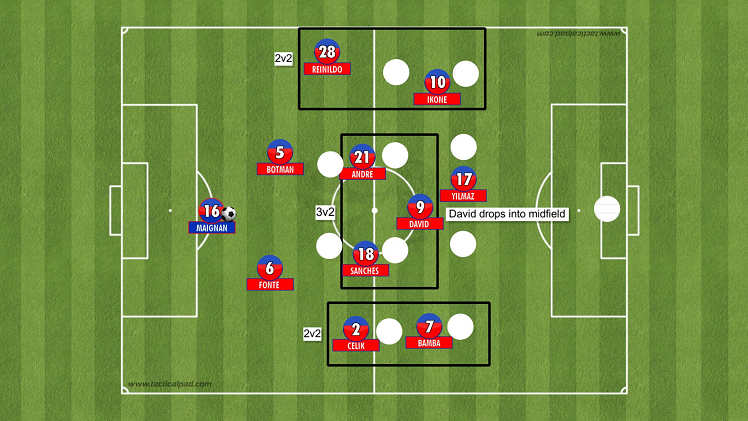
When evaluating transition dynamics, examining the exact layout of a team’s rest defense explains why attacking momentum regularly creates defensive liabilities.
Teams deploying asymmetric 4-3-3 systems often leave only two central defenders and a single defensive pivot behind the ball during sustained attacking sequences. When an opposing midfield turnover occurs, the spatial distance between the remaining defenders and the sideline spans over thirty meters.
First Phase: Wing-backs advance beyond the midfield line, forcing the lone pivot to cover expansive lateral territory.
Second Phase: An unforced turnover in the final third prevents the midfield from executing an immediate tactical foul.
Third Phase: The defensive line retreats toward the penalty area rather than closing down the ball carrier, inviting a targeted transition pass.
Fourth Phase: The opposing secondary runner attacks the unprotected blind side of the lone central anchor to generate an unhindered shot.
This sequence details how systemic positional vacuums guarantee opposing scoring opportunities irrespective of technical skill differences. Bettors recognizing this pattern understand that an underdog requires only a single clean vertical pass to capitalize on the favorite’s systematic overcommitment.
Pricing Discrepancies Across Alternative Wagering Channels
Market inefficiencies in Southeast Asian goal lines often arise because general sportsbooks peg BTTS pricing directly to total goal over/under thresholds rather than distinct team attributes. A match projected for Over 2.5 goals does not automatically carry equal probability for Both Teams to Score; a dominant 3-0 home victory hits the total while failing the BTTS premise entirely. When recreational money drives up the Over line on a mismatch, the BTTS price often drifts to attractive plus-money levels despite the favorite carrying clear defensive deficiencies.
Capital allocation shifts across different market segments underscore how experienced analysts locate these mathematical edges. A direct comparison of participant incentives reveals that while fixed-odds mechanics in a casino online website function on static probabilistic house rules, sports betting liquidity demands constant tracking of pricing lag and market adjustments, rewarding those who exploit mispriced correlations between match outcome handicaps and independent goal-concession rates.
Impact of Foreign Forward Suspensions and Roster Attrition
The viability of backing high-scoring yet defensively fragile sides collapses the moment individual offensive anchors are sidelined. Mid-tier Thai clubs typically concentrate over half their payroll on two or three decisive foreign finishers, meaning tactical coherence in the final third relies entirely on those players’ physical traits. When disciplinary suspensions or muscle strains occur, the team’s defensive weaknesses remain fully exposed while their capacity to answer on the scoreboard drops precipitously.
Bettors assessing these fixtures must track disciplinary tallies as closely as tactical setups. An aggressive side missing its primary target man will often retain its high-line vulnerabilities, conceding its usual quota of goals, but will lack the aerial presence or physical hold-up play required to unlock a low block. In these scenarios, what would typically be a reliable 2-1 or 2-2 fixture devolves into a one-sided 2-0 defeat, invalidating the foundational logic of the BTTS selection.
Line Clashes: Profiling the Ideal Opponent
A defensively porous club cannot generate a successful BTTS outcome in isolation; the opposing side must possess sufficient technical competence to punish open space. Backing this market fails most commonly when an expansive team faces an ultra-conservative bottom-tier side that completely refuses to engage in transition. Against such passive opposition, the favored offensive unit dominates territory, easily squashes sporadic long balls, and grinds out a sterile 1-0 or 2-0 clean sheet.
The optimal opponent profile is another mid-table side that employs direct, vertical counter-attacks rather than extended possession sequences. When two tactically open systems collide, game flow accelerates, transition turnovers multiply in central areas, and defensive recovery times diminish. Identifying these specific strategic pairings prevents bettors from entering positions where a stylistic stalemate suppresses two-way scoring action.
Liquidity Monitoring and Execution Timing
Executing value-driven positions on domestic markets demands careful observation of line movement throughout the matchday. Public money heavily tracks top-tier branding and historical reputations, frequently depressing prices on clean sheets for traditional powerhouses even when those teams have conceded in six consecutive fixtures. Astute market participants monitor early morning limits and wait for recreational action to inflate the opposing odds.
Analyzing execution windows highlights the necessity of using books that maintain deep exposure limits on regional leagues. Under conditions where localized market depth dictates rapid odds corrections right before kickoff, cross-checking movement on an established sports betting service like ufabet168 enables players to secure advantageous pricing before sharp money cleans out available value on vulnerable defenses.
Summary
Exploiting the Both Teams to Score market in the 2019 and 2020 Thai League demanded identifying tactical overextension rather than raw scoring volume. Teams characterized by aggressive territorial pressing and foreign-dependent forward lines consistently generated goals while remaining structurally vulnerable to rapid transitions. Long-term profitability relied on isolating these specific rest-defense flaws, confirming the presence of key attacking personnel, and capitalizing on pricing models that failed to decouple match totals from two-way scoring probabilities.